Roadside Empire: Idle Tycoon
- 4.3
- Rating
- 10.00M
- Installs
- Free
- Price

 Analysis by App-foxy
I spent time with Roadside Empire: Idle Tycoon as a casual business simulation, and its central idea is easy to understand: start with a modest roadside fuel stop, improve the operation, and turn a small business into a larger one. It is a free game from Highcore Labs LLC, aimed at Everyone, and it sits firmly in the relaxed management corner of mobile gaming rather than trying to be a deep economic simulator.
That distinction matters. I would not install this expecting the detailed planning of a full PC tycoon game. I would install it when I want short management sessions, visible progress, and something that can fit around a commute or a quiet break. The appeal comes from watching a simple petrol station become more valuable through repeated upgrades, while the idle structure gives the game a reason to keep moving even when I am not giving it constant attention.
Its public reception is reasonably strong, with a 4.2 average from around 133 thousand ratings and over 10 million installs. Those figures suggest that the basic loop connects with a large audience, but they do not automatically make it the right choice for everyone. My experience was more positive when I treated it as a light, forgiving time-filler than when I looked for a demanding strategy game.
You May Also Like

 Blood Strike: 2.5 Anniversary
Blood Strike’s Loadouts Turn Every Drop Into a Tactical Gamble
A close look at Blood Strike’s custom loadouts: how fast access to signature weapons reshapes its battle royale rhythm, rewards preparation, and narrows the gap between fights.

 Pandora - Music & Podcasts
Pandora’s Music Is Easy to Start, but Harder to Recover
Pandora’s strength is its low-effort path from a seed to a station. Its weak spot is how much confidence it asks you to place in connection, setup, and quiet recovery.

 8 Ball Pool
 Is Built on Rivalries, Rematches, and Routine
A close look at the rivalries, rematches, shared routines, and unanswered safety questions that turn a quick pool match into a persistent mobile community.

 Samsung Music
’s Quiet Strength Is Playing What You Already Own
Its reach comes less from spectacle than from dependable access to a personal library. That simplicity is both the app’s strongest retention engine and its ceiling.

 AccuWeather: Weather Radar
AccuWeather Review: A Quick, Clear Forecast for Everyday Decisions
For everyday plans, the best forecast is the one you can understand quickly. AccuWeather makes rain timing, radar, and local conditions easy to act on, with a few trade-offs.

 Hill Climb Racing
Why Hill Climb Racing Still Turns Crashes Into One More Run
A tiny car, a bumpy hill and one more upgrade: Hill Climb Racing keeps resurfacing because its simple chaos makes every near-miss feel personal.
More From Our News Desk



What the roadside business loop feels like
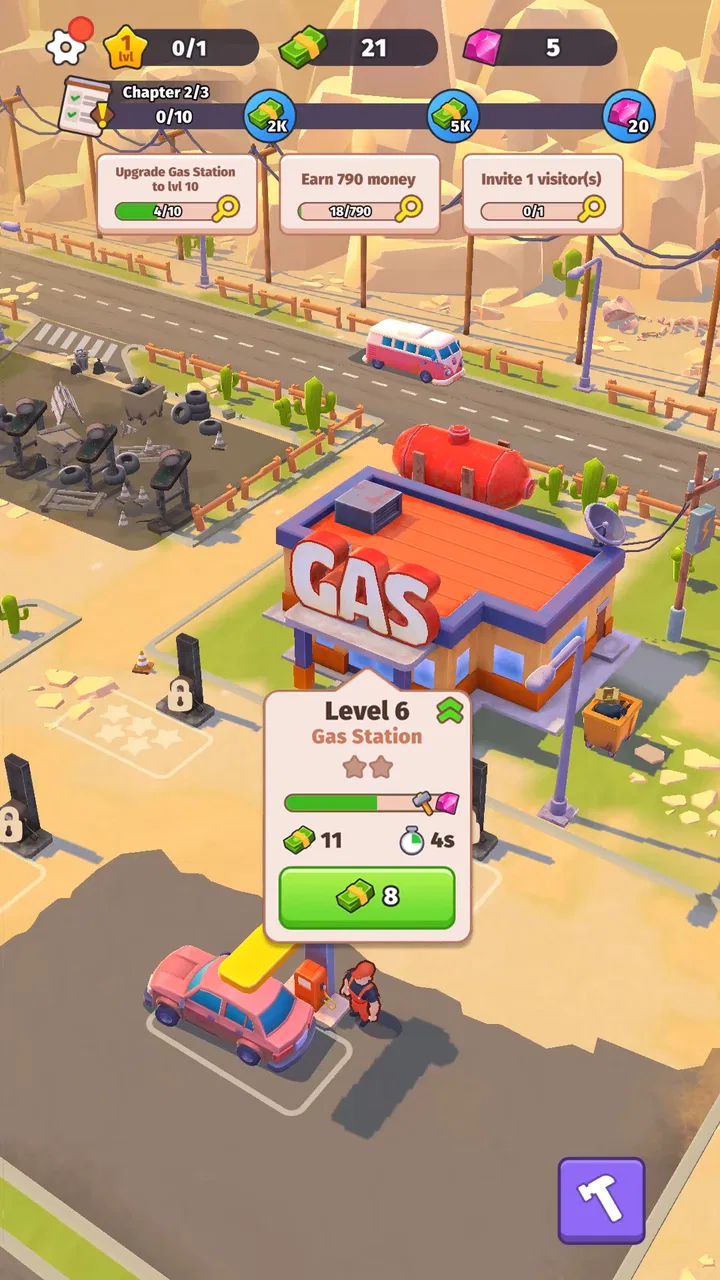
The first minutes are built around learning the relationship between earning and reinvesting. The station is not just a backdrop; it is the reason every improvement feels understandable. I am encouraged to think about the business as a growing chain of small decisions rather than one complicated master plan. That makes the game approachable for someone who normally avoids management titles.
The best part of this design is its clear feedback. A station that earns more gives me a reason to continue, and the next improvement feels connected to what I have already done. I never had to begin by studying a dense interface or memorizing a long list of systems. That simplicity is a strength on a phone, especially when I only have a few minutes.
At the same time, simplicity creates a ceiling. The game is unlikely to satisfy players who want detailed supply planning, staff scheduling, traffic analysis, or a fully simulated fuel market. Its pleasure is in the rhythm of collecting progress and improving the business, not in solving a complex chain of economic problems. If you prefer games where one poor decision can reshape an entire campaign, this may feel too gentle.
Why the idle format works in everyday use
I found the idle structure most useful when I treated it as a check-in game. A realistic routine would be opening it during a lunch break, reviewing the station, spending earned money on a sensible improvement, and closing it again. That workflow is more satisfying than leaving the game open constantly, because each return gives the feeling that the business has continued to matter between sessions.
The offline emphasis is also important for this use case. The game is presented as something that can continue supporting play without a permanent connection, which makes it a practical companion for travel, waiting rooms, or places with unreliable service. I would still avoid assuming that every surrounding function behaves identically offline; the safest expectation is that the core earning-and-upgrade routine is the part designed for that situation.
One useful habit is to avoid spending every bit of progress immediately. Keeping a small reserve gives me flexibility when the next improvement is more valuable than a minor purchase available right now. This is not a complicated optimization trick, but it prevents the common idle-game mistake of turning every return visit into automatic tapping without considering the next meaningful step.
Progression feels better when I set a stopping point
Idle games can become repetitive when every session follows the same collection pattern. I got more enjoyment from setting a small target before closing the app: reach the next upgrade, build a reserve, or improve one part of the station rather than touching everything at once. That approach gives each visit a purpose and makes the business feel more like a project.
There is a trade-off here. The game’s accessible structure means I can understand what I am doing quickly, but it also means the long-term challenge depends heavily on whether I enjoy incremental progress. Players who need constant surprises may find the loop loses energy once the novelty of the roadside setting fades.
Another practical tip is to judge an upgrade by how it changes the next few visits, not only by its immediate visual appeal. In a game built around an expanding business, an improvement that strengthens future earnings can be more satisfying than one that simply feels like a short-term reward. The interface encourages progress, but the player still benefits from pausing to decide which progress is actually useful.
Spending, pressure, and fairness
Roadside Empire: Idle Tycoon is free to download and includes in-app purchases ranging from $0.99 to $99.99 per item. That is the key purchase context I would want a new player to understand before starting. The game can be approached without an entry fee, but the presence of optional paid items means the experience belongs to the familiar free-to-play model rather than a one-time purchase model.
I cannot fairly claim that spending is required, or that every purchase is harmless, without a clearly documented breakdown of how each item affects progression. What I can say is that the price range stretches from a small impulse purchase to a much larger commitment. I would therefore treat buying as something to decide in advance, not something to do automatically when progress slows.
My personal rule would be simple: play the free loop first, see whether the station management itself remains enjoyable, and only then consider spending. If the game is already fun at a relaxed pace, a purchase is easier to evaluate as convenience rather than rescue. If the only enjoyable moments come after accelerating progress, that is a warning that the underlying loop may not suit me.
For families, the Everyone rating makes the game broadly accessible from a content perspective, but that should not be confused with unrestricted purchasing. A child can enjoy the management theme while still needing sensible device-level purchase controls. The important question is not only whether the content is suitable; it is whether spending decisions are kept deliberate.
Does paying make the management less satisfying?
This is where I would keep expectations measured. In any idle business game, faster progress can reduce the satisfaction of earning the next improvement naturally. If a paid item removes too much waiting, it may make the station grow quickly while making my decisions feel less important. On the other hand, a player who has already accepted the game as a short casual distraction may value convenience more than challenge.
The fair way to approach the purchase system is to separate two goals. If I want a calm progression game, I should protect the slower rhythm and avoid buying simply because I am impatient. If I want a quick look at the later business stages and do not mind paying for time saved, the purchase range gives room for different levels of commitment. The right choice depends on what I want the game to be, not on a promise that spending will improve every player’s experience.
I also would not compare the largest listed purchase with the cost of a premium simulation as if they offered the same thing. A free mobile idle game and a paid, feature-rich management title have different expectations. The former offers convenience and short sessions; the latter may offer more control and a more complete sense of ownership. That difference is central to deciding whether this game feels fair to me.
Competitive fairness and the limits of comparison
This is primarily a personal progression experience, so I judge fairness by whether my own choices still matter without paying. I do not have enough confirmed detail to describe a specific competitive ranking system or claim that players directly compete for an advantage. Because of that, I would not market it to someone looking for a serious contest against other managers.
For a casual player, the absence of a competitive expectation can be a benefit. I can focus on improving my station without worrying that another player’s spending has made my progress meaningless. The game works best when I see the business as my own ongoing project rather than as a scoreboard that must be conquered.
For a competitive player, the uncertainty is more important. Before investing money or time, I would want to understand exactly whether purchases affect any shared rankings, timed events, or player-versus-player elements. Those details should be checked in the current in-game purchase and feature screens rather than assumed from the idle-tycoon label. My trust verdict is stronger for solo entertainment than for competitive fairness claims.
Compared with a conventional city builder, this roadside business has a narrower fantasy and a more focused loop. A city builder usually asks me to balance several civic systems and think about a large population. Here, the roadside setting keeps the goal concrete: make the station more productive and grow the business. Compared with a pure clicker, it offers a more recognizable management frame, which gives the tapping and upgrading a clearer purpose.
Compared with a premium simulation, however, I would expect less depth and less control. A paid alternative may be better for someone who wants detailed budgets, long campaigns, and consequences that remain meaningful for hours. Roadside Empire is better suited to someone who values immediate feedback and easy sessions over exhaustive realism.
Who should play and who should skip it
I would recommend it to players who enjoy watching a small operation grow, like idle progression, and want a game that does not demand a long uninterrupted session. It is also a good fit for people who enjoy business themes but find traditional management games intimidating. The Everyone rating and straightforward premise make it easy to share with a broad audience, provided spending controls are handled responsibly.
I would be more cautious recommending it to players who dislike waiting, repeated collection routines, or free-to-play purchase prompts. It is also not my first choice for someone who wants a realistic petrol-station simulation. The roadside theme may sound more detailed than the actual management experience feels, especially if the player expects to control every operational decision.
It is a poor match for anyone who needs a strong competitive identity. Without treating it as a confirmed multiplayer contest, I would not choose it to replace a strategy game built around rankings, direct rivalry, or carefully balanced player-versus-player decisions.
Version, accessibility, and long-term trust
The game was released on June 28, 2024, and the current version is 1.36.0. It supports devices running Android 7.1 or later, which gives it a reasonably broad technical reach for Android users. Those details make it easier to decide whether an older phone can run it, but they do not tell me how every device will handle performance, battery use, or background behavior.
I would begin on a device that has enough free storage and keep expectations realistic about idle games in general: leaving any app active for long periods can be less convenient than opening it for brief check-ins. The most comfortable routine is to play intentionally, close the game, and return later rather than treating it like a dashboard that must remain open all day.
Long-term trust comes from knowing what I am buying and why. Here, the free entry point is clear, and the in-app purchase range is clear enough to justify caution. What remains important for each player is reading the purchase confirmation carefully and checking the current game screens before paying. I would never spend because a progress bar made me feel rushed.
The same principle applies to updates. A current version number tells me which release line I am reviewing, but mobile games can change their balance and presentation over time. If a future update alters the rhythm, prices, or available systems, my recommendation should be revisited rather than treated as permanent. That is especially relevant for a free game whose ongoing development shapes the experience.
What I would like to know before installing
The first question is whether it can be enjoyed without purchases. My answer is that I would start free and evaluate the natural pace before spending. The game’s core appeal is its incremental business loop, so paying before discovering whether that loop suits me would be backwards.
The second question is whether it is genuinely playable offline. Its presentation specifically supports offline earning and progress, making it attractive for disconnected moments. I would use it with that expectation for the central routine, while remembering that any feature dependent on current online services may follow different rules.
The third question is whether it is a deep simulator. I would answer no, at least not in the sense of a detailed economic sandbox. It is a lighter simulation designed around a roadside business and idle growth. That is not a flaw unless I install it expecting the complexity of a dedicated management game.
The fourth question is whether a child can use it safely. The content rating is Everyone, which makes the theme broadly suitable, but the paid items mean I would still use purchase protections on a shared device. Suitability of content and control over spending are separate responsibilities.
The final question is whether it is worth keeping installed. For me, the answer depends on whether the small daily decisions remain pleasant after the initial growth phase. If I enjoy setting targets and watching the station improve, it can stay as an easy background game. If I begin opening it only to collect and close without interest in the next decision, a more substantial simulation would be a better use of my time.
My trust verdict after playing
Roadside Empire: Idle Tycoon succeeds because it keeps its fantasy understandable. I know why I am returning, what the station represents, and how each improvement fits the larger idea of building a roadside business. Highcore Labs LLC has positioned it as an approachable simulation rather than a demanding strategy title, and that is the standard I would use to judge it.
The most trustworthy way to play is to treat spending as optional convenience, never as a requirement for keeping up. The free starting point makes experimentation easy, while the purchase range means I would approach larger payments with care. I appreciate that the game can suit short offline sessions, but I would not promise a perfectly pressure-free experience or claim that purchases have no effect without more detailed, current information inside the game.
My final recommendation is positive but specific. Install it if you want a relaxed petrol-station management game with idle progress, simple goals, and a business theme that is easy to understand. Skip it if you need deep simulation, intense competition, or a single upfront price with no purchase decisions. For the right player, Roadside Empire: Idle Tycoon is a pleasant little routine: check the station, choose the next useful improvement, and let the roadside empire grow at a pace that still feels like your own.
FAQs for Roadside Empire: Idle Tycoon
01What is Roadside Empire: Idle Tycoon about?
Roadside Empire: Idle Tycoon is a casual management game focused on building and expanding a roadside business empire. You typically begin with a small operation and gradually unlock new facilities, services, and locations. The main appeal is its idle progression system: businesses continue generating income while you are away, allowing you to return, collect profits, upgrade your empire, and make decisions that improve long-term growth.
02Can I play Roadside Empire: Idle Tycoon without an internet connection?
The game may allow some basic progress while offline, but an internet connection is generally recommended for the complete experience. Online access can be required for advertisements, cloud synchronization, special events, updates, and in-app purchase verification. Offline earnings may also be limited or calculated differently depending on the current version, so players should not assume every feature will work without an active connection.
03Is Roadside Empire: Idle Tycoon free to download and play?
Roadside Empire: Idle Tycoon is generally available as a free-to-play title, meaning you can download it without paying an upfront purchase price. However, the game may include optional in-app purchases for premium currency, boosts, upgrades, or other conveniences. Advertisements can also be part of the progression system, sometimes offering rewards in exchange for watching them. Spending is optional, but it may speed up development.
04Does the game require constant active playing?
No, constant attention is not usually necessary because Roadside Empire: Idle Tycoon is designed around idle and incremental mechanics. Your businesses can continue producing resources between sessions, allowing you to check in periodically rather than remain in the game all day. Active play is still useful for collecting earnings, completing objectives, watching reward advertisements, and choosing upgrades that help maximize your progress.
05Is Roadside Empire: Idle Tycoon suitable for children and casual players?
The game is generally easy to understand and suitable for casual players who enjoy simple management, upgrading, and incremental progression. Its controls and goals are usually more accessible than those of complex strategy games. Parents should still review the age rating, advertising practices, and available in-app purchases before allowing children to play, since store classifications and monetization features can vary by platform and region.
Pros
- Simple idle mechanics make progress easy to follow.
- Offline earnings help maintain progress without constant play.
- Roadside businesses offer a satisfying sense of expansion.
- Short sessions suit casual players and busy schedules.
- Upgrades are clearly presented and easy to understand.
Cons
- Progress can slow noticeably after the early stages.
- Frequent upgrade decisions may feel repetitive over time.
- Some rewards and boosts may encourage watching advertisements.
- Limited strategic depth could disappoint experienced tycoon players.
- Device performance may suffer during longer play sessions.

Roadside Empire: Idle Tycoon
Gallery